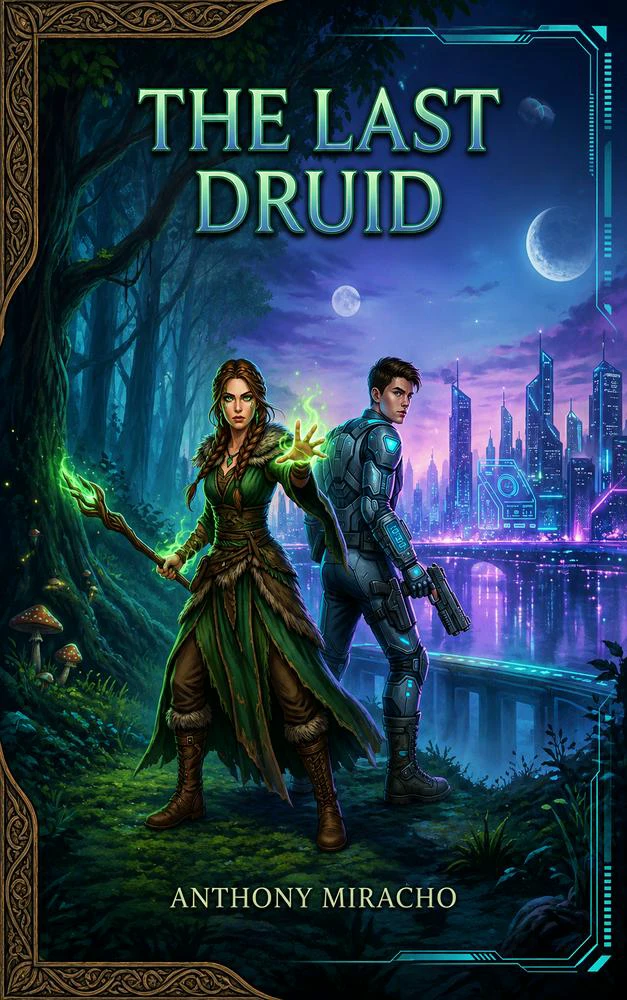
Prologue:
Randrick stood by the floor-to-ceiling glass, watching the Capital indulge in the foolish delusion of recovery.
It was an unwelcome sight. For years, the city had maintained a sensible, obedient monochrome - gray concrete, gray streets, gray spirits. Now, color was creeping into the lower quarters like a bad stain. Citizens were lingering on street corners, laughing, breathing a little too deeply.
Hope. A staggering lapse in civic discipline.
He rested his chin on a gloved hand, watching a small crowd gather near the square. They were walking taller. They were raising their voices. Give a man bread, and he asks for butter; give him a sky free of ash, and suddenly he fancies himself a philosopher. It was an audacity he found almost endearing, if it weren’t so profoundly inconvenient.
'Ingrates,' he mused, a small, wry smirk touching his lips. 'They treat peace as an inherent right, completely forgetting who negotiated the lease.'
They mistook his restraint for weakness.
He turned abruptly from the glass and walked smoothly toward his desk, his long coat billowing behind him. If they wished to play at quiet rebellion, he would gladly direct the theater. Fear had always been the most reliable currency - far less prone to inflation than hope, and remarkably easy to print.
He sat down, smoothing a sheet of heavy parchment, and dipped his quill with practiced poise.
First, the stagecraft. He would quietly commission a cadre of violent outcasts - desperate men with sharp edges and no moral compass, basically psychopaths - to orchestrate a series of precise, terrifying atrocities across the city. Random violence. Unprovable origins. And just as the panic reached a fever pitch, his high-ranking protectors would ride in to extinguish the threat with heroic flare. People would value his empire's protection.
Second, the sky. The synthetic sun hovering over the toxic haze was a marvel of modern engineering, but its true genius lay in its dimmer switch. He would extend its cycle, forcing fourteen hours of merciless daylight onto the workforce. Coupled with a subtle bump in the daily tariffs, the citizens would spend their days sweating and their nights starving. The high taxes would be in the name of protection and development
A tired man doesn't march on the palace. A tired man goes to bed.
He glanced at the ledger containing the names of his top commanders. They followed him with a devotion that bordered on religious, utterly convinced they owed him their lives. He almost felt a pang of pride for how neatly he’d orchestrated their devotion. He hadn't recruited loyal men; he had shattered them first, ruined their lives, stripped away their dignity, and then stepped out of the shadows to offer them a hand up. Loyalty, he had learned early on, was never bought - it was manufactured from rock bottom.
Randrick leaned back, watching the ink dry on the parchment, thoroughly pleased with the elegance of it all.
He let out a low, quiet chuckle into the empty room. "Honestly, I could teach the Devil a thing or two."
Chapter 1: The Girl Who Talked to Dirt
Elara
The ash fell like dirty snow. Same as always. Same as every morning I'd woken up in this grey hell, same as every night I'd closed my eyes wondering if tomorrow would be the day I finally choked on it.
I wiped my forehead with the back of my hand, smearing grime across already-grimy skin. Another day in paradise. And by paradise, I meant the outer sectors of the Empire - where the air tasted like rust and hope went to die in a corner, probably next to whatever I was about to haul.
My shift at the filtration plant was finally over. Twelve hours of dragging contaminated sludge, breathing through a mask that did approximately nothing, and pretending I didn't notice the way my coworkers' eyes glazed over when they looked at the horizon. We'd all given up on the horizon. There was nothing out there but more grey and the occasional scavenger picking through the wreckage of someone else's broken life. No one was coming to save us.
"Hey, Root Girl!" Someone called from across the processing floor. I didn't bother turning around. I knew that voice. Markus. My shift supervisor. A man whose personality was as pleasant as the toxic runoff we processed and whose face looked like someone had tried to sculpt it with a potato peeler.
"It's Elara," I muttered under my breath, but I turned anyway. Mouth shut. Head down. That's how you survived in this era. "What?"
Markus gestured vaguely toward a mountain of what I could only describe as 'garbage that had given up on life.' "Need you to clear section D before you go. High Commander's inspection tomorrow. Everything needs to look..." he paused, searching for a word his limited vocabulary couldn’t seem to grasp. "Not like this."
I looked at the mountain of refuse. I looked at my watch. I looked at the exit, which was approximately fifty feet away and represented freedom, food, and maybe a nap if I was lucky.
"Section D," I repeated flatly. "By myself."
"You got legs, don't you?" Markus grinned, revealing a mouthful of teeth that hadn't seen a dentist since the Before Times. "Get moving. And try not to break anything expensive. We can't afford to replace you."
'Can't afford to replace me'. I trudged toward the garbage pile, my boots scraping against the grimy floor. What a joke. They could swap me out for literally anyone at any time and get the exact same productivity. But jobs were nearly impossible to come by, so you shut up and did what you were told. No one could afford to get fired - ever. Finding another gig was a pipe dream, and we all knew it. That's why he could afford to be an ass, and nobody called him for it.
The filtration plant sat on the edge of Sector 47, one of the outer rings of the Empire's territory. Once, years ago, this had been a thriving agricultural region. My grandmother used to tell me stories about it, back when I was small enough to sit on her knee and believe in magic.
I remembered the smell of her. That's the thing about the before-times, the way she'd describe them - I couldn't picture the green fields or the blue sky, but I could still remember the way she smelled. Like soil and something sweet. Like something that had once been alive.
"Animals everywhere," she'd say, her eyes growing distant and dreamy. "Not just the livestock we kept for food, but wild ones too. Deer with antlers like tree branches. Rabbits that would pop out of holes in the ground. Birds - oh, the birds, Elara. They would fill the sky like a living carpet, their songs so loud you couldn't hear yourself think - especially at dawn. She would close her eyes and breathe deeply, as if trying to pull the memory back into the present.
And I'd close my eyes too and try to imagine it. A world that wasn't grey. A world that wasn't dead. A world where you could open your mouth and breathe without tasting ash and regret.
But those days were gone. Long gone. They survived only as faded myths to those of us born too late to ever see them with our own eyes. Now it was a graveyard of dead soil and broken dreams. The Empire had sucked everything out of the land - minerals, water, life itself - to feed their gleaming Capital in the center of what used to be the continent.
"The animals were the best part," she'd continue, and her voice would get soft and sad. "I remember the smell of fresh milk in the mornings. The sound of chickens clucking. And the horses - oh, how I loved the horses. They were so big and gentle. I'd brush their manes for hours, just talking to them."
I'd never even seen a horse except in the old picture books my grandmother had hidden under her mattress. They looked like creatures from another world - muscular and proud, their manes flowing in the wind. I used to dream about them. About riding one across a green field, the wind in my hair, the sun on my face.
But those were just dreams. Out in the fringe sectors, the only animals you ever saw were the ones bred by the Empire for labor or slaughter - pale, sickly beasts barely clinging to life in the contamination. Their eyes were dull and hollow, as though they had surrendered to the bleakness long before the end. Just like the rest of us.
"Don't forget what they took from us," my grandmother would whisper, her hand gripping mine. "The world was beautiful once. It could be beautiful again. You have to believe that, Elara. You have to keep hoping."
I believed her, even when it felt foolish. Even when the ash filled my lungs and the grey skies stretched on forever.
I forced myself to believe. Giving up hope meant giving up the fight, and if we stopped fighting, the world was truly lost. 'There has to be something better than this.' It was the only thought keeping me tethered to life.
But there was something I never told my grandmother.
Something that had started happening to me around the time I turned twelve, when the green veins first appeared in my irises and I realized I wasn't like everyone else.
I could hear the earth.
Not with my ears - with something deeper. Something that lived in my bones and my blood and the spaces between my thoughts, something tethered to my being. It wasn't a voice exactly. It was more like a feeling, a hum, a vibration that traveled up through my feet and into my chest. It was the heartbeat of the world, and it was dying. And ever since I discovered it, I loved walking bare footed - it felt like home.
I didn't know what to call it at first. I thought I was going crazy. That the contamination had finally gotten to my brain, that I was losing my mind the way so many sector workers did. But the feeling didn't go away. It got stronger. And eventually, I learned to listen.
That's when I first heard her.
'Isla.'
The name came to me in a whisper, soft as wind through dead grass. Not a word, exactly - more like a feeling that carried meaning. The earth. The spirit of the living world. The consciousness that had been there since the beginning, before the Empire, before the burning, before humanity had forgotten how to listen.
And she was in so much pain.
As I grew, our bond deepened, bound together by shared suffering. In time, I learned to endure her pain as my own. It would hit like a cold dread settling in my gut, a heavy weight pressing on my chest until breathing became a chore. Other times it arrived without warning - a sharp, sudden agony so fierce it doubled me over, hands clutching my stomach as I struggled to make sense of the blow.
Those were the times when the Empire drilled deep. When they ripped minerals from the earth, tore open its veins and drained them dry - drain parts that were never meant to be touched. Isla would scream, and I would feel every second of it.
And then there was the grief. The slow, constant grief of a world dying by inches. It was there all the time, a dull ache in the background of my existence, so familiar I'd almost stopped noticing it.
Almost.
I reached Section D and stared at the task ahead. The pile was mostly empty chemical containers, broken machinery, and - I squinted - was that someone's entire wardrobe? Great.
My hands found the metal of the first container. I began to drag it toward the processing chute, ignoring the way my muscles screamed in protest. Five years of this. Five years of manual labor, of eating nutrient paste that tasted like regret, of pretending I was just another faceless worker in the Empire's vast machine.
But I wasn't. I knew I wasn't. And that was the terrifying part.
I paused, letting go of the container for just a moment. I looked around. No one was watching. Markus had wandered off to terrorize someone else. The other workers on my shift were too exhausted to notice anything beyond their own misery.
I let my eyes drift closed. Just for a second.
Beneath my feet, I felt it. I felt her. Isla. That faint whisper of something alive, buried deep under layers of concrete and dead earth. Her pulse was weak and distant, like a dying heartbeat.
'I'm here', I thought, reaching out with my senses. 'I'm still here.'
The earth didn't answer. It was too far gone, too drained, especially this part of town. But I felt the memory of what it used to be. Forests. Rivers. Creatures that didn't have to wear filtration masks just to exist.
And I felt something else too. Isla's pain.
It came in a wave, so sudden and sharp that I gasped. The Empire was drilling again. Somewhere, deep into the earth, machines were tearing into Isla, ripping out everything she had left. If this kept up she would eventually collapse - and who knows what would happen next.
I could feel it. The agony of being torn open, of having your insides ripped out while you were still alive. It was overwhelming, dizzying, too much to bear.
"Elara! You okay?"
I opened my eyes to find one of the other workers staring at me. Mira. She was about my age, had been on the same shift for the past two years. One of the few people in this place who was actually kind to me.
"Yeah," I said, forcing a smile. "Just... tired. You know how it is."
Mira nodded, her expression sympathetic. "Get some rest after this. You look terrible."
"Thanks," I said dryly. "Always good to hear."
She laughed and moved on, and I was alone again with the garbage and the grief.
The walk back to my apartment took forty minutes. I could have taken the transit pod, but that would have cost credits I didn't have. So I walked, through the narrow alleys of Sector 47, past the endless rows of identical housing units, past the vendors selling questionable food from carts that had seen better years.
The air was thick with contamination. I could taste it on my tongue, a bitter metallic tang that never quite went away. The mask I wore helped a little, but not much.
My grandmother used to tell me about fresh air. "You could breathe it in and feel your lungs expand," she'd say. "It smelled like flowers and grass and rain. It smelled like life." And for the hundredth time, I wondered if the people of that era ever truly appreciated the miracle of fresh air.
I couldn't even imagine that. The only smells I knew were ash and chemicals and the sour stench of desperation.
My apartment was on the fourteenth floor of a building that had been old when my grandmother was young. The elevator hadn't worked in years, so I climbed the stairs, my joints popping in protest with each step.
Inside, I locked the door, checked the windows, and collapsed onto my mattress. It wasn't much - a thin pad on the floor, a single blanket, a small table with a burner for heating water. But it was mine. And more importantly, it was private.
I reached under my mattress and pulled out my secret. It wasn't much. Just a small pot, no bigger than my fist, filled with soil I'd smuggled from the greenhouses in Sector 47. The greenhouses were one of the Empire's few concessions to the outer sectors - places where they grew actual food for the elite. But the soil there was contaminated, just like everything else. It needed help.
I placed the pot on my table and sat before it. Lately, a faint tremor of life had been vibrating through the me, and I needed to understand what it meant. Operating on pure instinct, my fingers drifted to the dirt, brushing it gently.
"Hey," I whispered. "It's me again."
The soil felt dry. Lifeless. Just ordinary dirt, no different from any other patch in the sector.
But I could feel it: a microscopic spark buried deep within, something that still remembered what it meant to be alive.
I closed my eyes, breathed, and reached.
The world shifted. A thread of connection - thin as a spiderweb - stretched from my fingertips into the earth. I followed it down, pressing past the contamination and the dead zones, until I finally touched what I was looking for.
Isla.
She endured somewhere in the dark depths below, a fragile ember of warmth against the cold, dead soil. Her pulse was a ghost of a sensation, so faint it nearly slipped away. Yet the soil in the pot held her signal, acting as a bridge that tethered my mind directly to hers.
I shared my power with her. A tiny trickle of life, a whisper of hope in the darkness. It wasn't much - a bucket of water in a vast ocean - but it was all I had. And she always made me feel appreciated, even when I knew it wasn't enough.
The soil responded. A tiny green shoot pushed up through the dirt, thin and fragile, but undeniably alive. It unfurled two tiny leaves, and for just a moment, I could smell something other than ash.
I opened my eyes and smiled. The plant was small, barely an inch tall, but it was beautiful. It was proof that life could still exist, even in this dead world.
"You're absolutely breathtaking," I told the plant. "You know that, right?"
The plant didn't answer. Plants never did. But it grew a little taller, as if in defiance of everything the Empire had done to the world.
I let myself enjoy the moment for a few more seconds before carefully hiding the pot back under my mattress. If anyone found out about my little secret, I'd be arrested. Tortured. Executed. Druids were treated as terrorists. Druids were the reason the world was dead, or so the Empire preached.
I didn't know the truth. I didn't know how the world had ended, or why I had the ability to make things grow or connect to Isla. All I knew was that I had to hide it. Because if the Empire found out, they wouldn't just kill me. They would destroy everything about me.
My stomach growled. Right. Food.
I opened my small cabinet and examined my rations. Three more nutrient bars, a packet of dried something that might have been vegetables once, and a small container of water that was probably safe to drink.
I grabbed a nutrient bar and chewed on it absently while staring at the blank wall of my apartment. The bar tasted like cardboard. I washed it down with a sip of water that tasted faintly of dust.
Grandmother loved to speak of real food, back when it still existed. "Mangoes," she'd whisper, a rare warmth breaking across her face. "Red and round, bursting with juice so sweet it made your teeth ache. And real bread. Not the processed slime we get. Real bread was warm, pillow-soft, and smelled like pure magic."
I'd never tasted or seen a mango. I'd never eaten real bread. The closest I'd ever come was the nutrient bars, which were designed to keep you alive and nothing else. Man, I wish I had been born in that era.
"One day," my grandmother would say, "you'll taste real food. You'll feel the sun on your face. You'll breathe fresh air. I promise."
She couldn't keep that promise. No one could. But I held onto it anyway, clutching it like a talisman against the darkness.
I was about to go to sleep when I felt it again. Isla's pain, sharp and sudden, like a knife twisting in my gut.
I doubled over, gasping, my hands clutching my stomach. It was worse than before. So much worse. The Empire was drilling again, deep beneath the city, and every stroke of their machines was a wound in Isla's flesh.
I could feel it. The agony of being torn open, of having your lifeblood ripped out and used to fuel a machine that was slowly killing you. Isla was screaming, and I could hear every word of it.
'Child', she seemed to cry out. 'Child, help me. Please. It hurts so much.'
Tears streamed down my face. I wanted to help her. I wanted to tear the Empire's machines apart with my bare hands, to cover the concrete with soil and water and life. All I could do was bear the pain with her.
"I'm sorry," I whispered. "I just don't know how."
The pain faded, leaving me trembling on the floor. Isla was still there, still dying, still waiting for a rescue that would never come.
I lay there for a long time, staring at the ceiling, feeling the weight of the world pressing down on me.
My grandmother passed away three years ago. Tech-smog got her, just like it got my aunt. She'd been sick for months before she died, coughing up black phlegm, her eyes growing dimmer and dimmer.
"Promise me," she said, her voice barely a whisper. "Promise me you'll keep going. Promise me you'll try to bring it back."
"Bring what back?" I asked, tears streaming down my face.
"The world," she said. "The beautiful world it once was."
I held her hand as she slipped away, and I made that promise. But how was I supposed to bring it back?
It's hard. So hard. Some days, I wake up and I can barely find the strength to get out of bed. The grey is everywhere. In the sky. In the air. In my soul.
And then I would remember her. I remember the stories she told me about the deer and the birds and the horses. I remember the way her eyes would light up when she talked about the flowers and the bees and the fireflies.
And I keep going.
But tonight, lying on my mattress with Isla's pain still echoing in my bones, I felt something different. Something that had been growing in me for a long time.
Hope.
It was small and fragile, like the plant I'd just grown. But it was there, persistent and stubborn, refusing to die. Perhaps helping Isla would lead to keeping my grandma's promise.
I reached under my mattress and pulled out the pot again. The plant was still there, tiny and green, a little defiance against the grey.
"We're going to get through this," I whispered. "Both of us. I don't know how, but we will."
The plant seemed to lean toward me, as if it understood.
Maybe I was crazy. Maybe the contamination had finally gotten to my brain, and I was imagining things that weren't there. Maybe I was just a sad, lonely girl talking to a plant because I had no one else to talk to.
But I didn't think so. Because I could feel Isla. I could feel her warmth in the soil, her pulse in the earth. She was real, and she was dying, and I was the only one who could save her.
I tucked the pot back under my mattress and lay down on my bed. The plant's presence was a comfort, a tiny spark of life in the dead grey world.
For the first time in weeks, I fell asleep smiling.
I dreamed of Isla for the first time that night.
She came to me in the dream, not as a voice or a feeling, but as a person. An old woman with green eyes and skin like bark, her hair flowing like grass in the wind. She was beautiful, in a wild and untamed way, but she was also wounded. Gashes covered her body, deep and bleeding, greenstuff oozing from her wounds and her eyes were filled with sorrow.
"Child," she said, and her voice was like wind through leaves. "Help me."
"Who are you?" I asked. "What are you?"
"I am Isla," she said. "I am everything that lives and breathes and grows. I am the soil beneath your feet and the air in your lungs. I am dying."
I reached out to touch her, but my hand passed through her like mist.
"Please," I said. "Tell me how to help you."
She smiled, sad and knowing. "You already know how, child. You've always known. The magic is in your blood, in your bones, in the very core of your being. You just have to believe in it."
"But I don't know what I'm doing," I said, tears streaming down my face. "I don't know how to use the magic. I don't know how to save you."
Isla reached out and touched my cheek. Her hand was warm, like sunlight on a summer day. Or that was what it felt like.
"You will," she said. "The path will reveal itself when you're ready. Just don't give up hope."
She began to fade, her form dissolving into mist.
"Wait!" I cried. "Don't go! I still have so many questions!"
"Come find me," she said, her voice growing faint. "Come back to the heart of the world. It's the only way."
And then she was gone, and I was alone in the dream, standing on a hill of green grass beneath a blue sky.
I woke with a gasp, my heart pounding. The dream was already fading, but Isla's words echoed in my mind.
'Come back to the heart of the world.'